

|
Getting your Trinity Audio player ready...
|
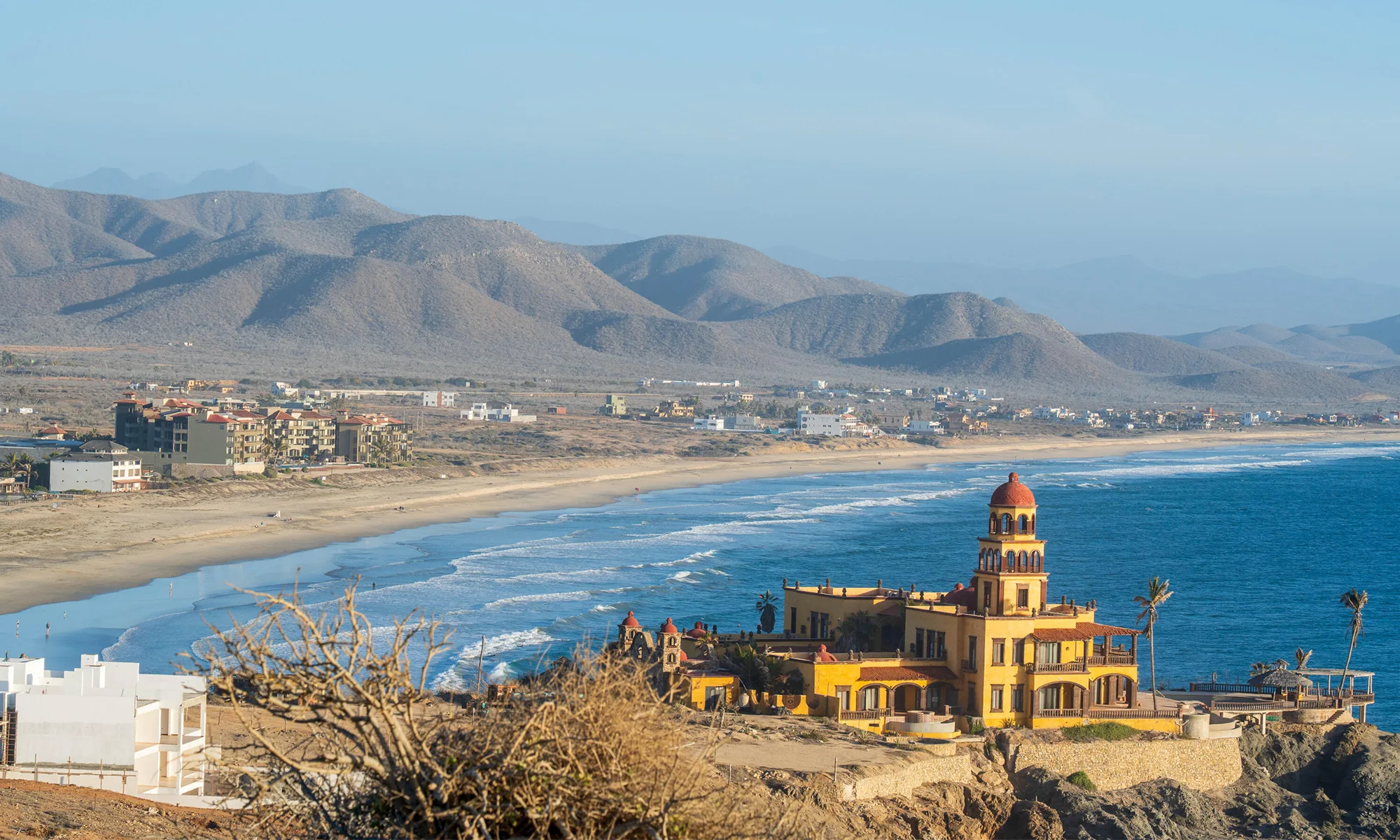
Along the Pacific side of Baja California Sur, Cerritos has been changing in ways that show up most clearly in what is selling and what is not. Smaller condo projects continue to come online, but many are moving more slowly than before, lingering on the market as prices rise.
At the same time, demand has concentrated elsewhere. The properties that sell are larger, lower-density homes, often built for longer-term use. Buyers arriving in Cerritos are asking different questions than they did a few years ago, focused less on finishes and more on land, exposure, infrastructure, and how a home fits into its surroundings. What’s emerging is not just a more expensive market, but one beginning to define the higher end on its own terms.
Why the High End Doesn’t Translate Cleanly
As prices rise in areas that were not originally built for luxury, assumptions begin to break down. The idea that the higher end will take the same shape everywhere carries over from larger resort markets, where scale, staffing, and infrastructure make certain forms of development possible. Outside of those environments, the logic changes.
Luxury does not arrive as a finished template. It takes shape through limits. Land availability, exposure, access to water and power, and the way people actually use their homes begin to matter more than surface polish. In smaller markets like Cerritos, those conditions do not soften as demand increases. They sharpen. And as buyers move upmarket, what they value starts to reflect that reality.
The Physical Limits That Redefine Value
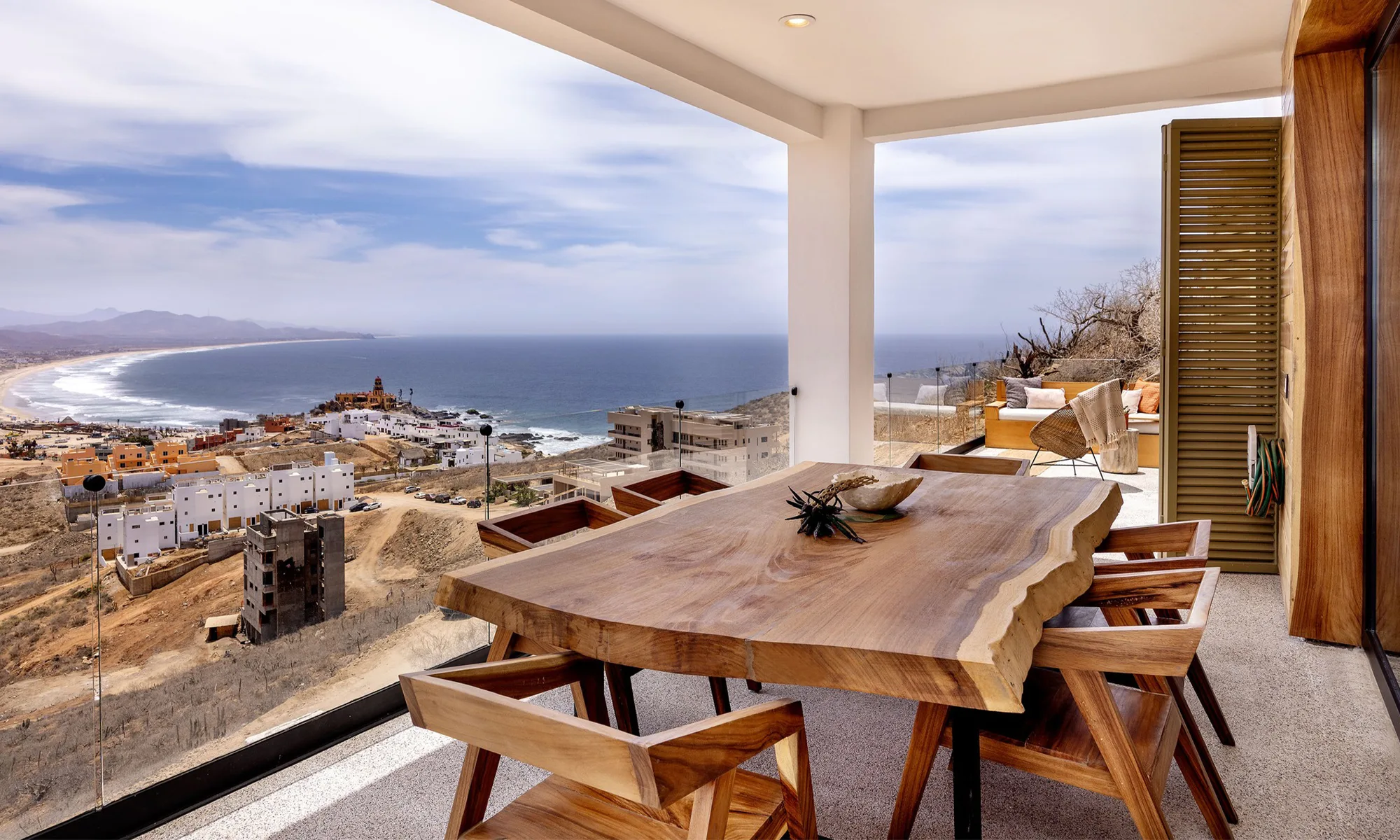
Photo by Baja House Hunters
In Cerritos, those limits are easy to see. The landscape is exposed and undeveloped. Infrastructure exists, but it is not scaled for density. Beachfront is finite, and much of it has already been absorbed. What remains are not blank canvases, but parcels shaped by wind, salt, access, and long stretches of isolation.
As demand has moved upmarket, buyers have not been asking for more services layered on top of these conditions. They have been asking how to live within them. Homes are expected to stand on their own, function without constant support, and remain usable over decades of wear. Scale matters, but density does too. Fewer neighbors, fewer shared systems, and a clearer relationship between house and land have become part of what defines the upper end here.
A Buyer Profile Comes Into Focus
The shift is not only structural. It is also human. Cerritos has begun to attract a narrower, more defined kind of buyer, one whose expectations are shaped as much by values as by budget. Many arrive with experience in other markets and a clear sense of what they do not want. They are less interested in managed environments and more focused on how a place will be used over time.
Karina Christensen, a real estate professional who works across the Pacific side of Baja California Sur, has watched that change take hold. In her experience, buyers looking at Cerritos today tend to plan further ahead. They prioritize space for extended family, privacy without isolation, and homes that can function independently in a demanding environment. Their questions focus on longevity, exposure, and self-sufficiency rather than on finishes or services.
Development as Interpretation
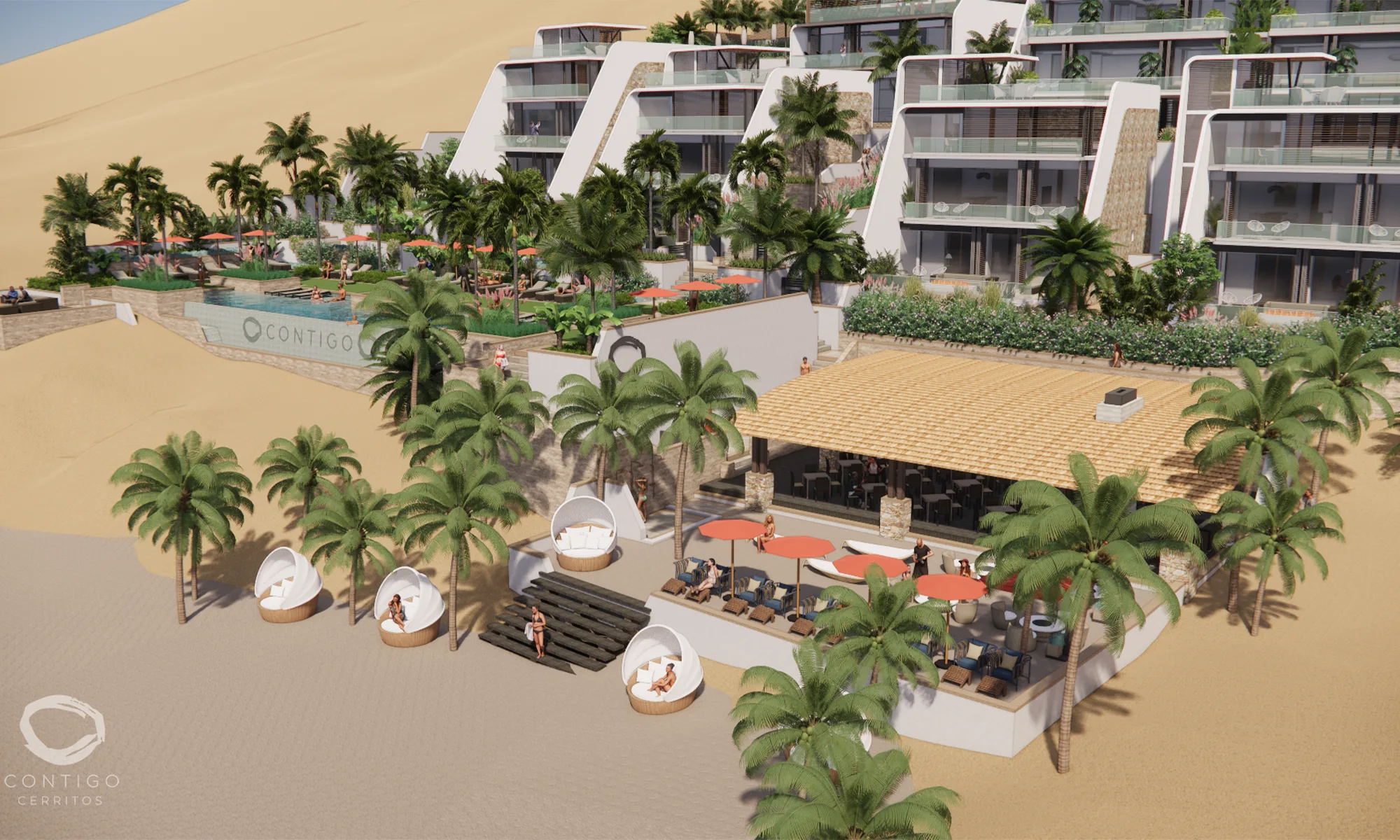
As developers respond to that audience, high-end projects here begin to take on a specific character. Lower density replaces amenity layering. Design decisions favor durability and restraint. The result is not a diluted version of luxury imported from elsewhere, but a form shaped by the people who choose this place and the reasons they choose it.
One response to this shift is Contigo Cerritos, a small beachfront project located between Cerritos Beach and Pescadero. The development consists of paired villas rather than condos, with a deliberately limited number of units. Homes are priced at roughly US$3 million, reflecting both their scale and the site’s constraints.
The design choices are less about signaling than about use. Density was reduced to preserve views and limit the use of shared systems. Infrastructure was treated as a core design problem, with on-site water generation, gray-water reuse, and solar power incorporated to reduce reliance on local networks. Materials and massing were selected to withstand long-term exposure rather than chase short-term appeal.
Karina is developing the project with her husband, Ron Sprengeler, positioning it as a long-term residential environment rather than a short-stay product. The goal, as she has described it, is to build homes intended to be lived in fully and passed through families over time. In that sense, the project reflects less an ambition to redefine the market than an attempt to respond precisely to what this one now demands.
Other projects, such as The Cove Residences, a limited collection of oceanfront homes with private outdoor amenities, point to a parallel interpretation of the same upper-tier demand.
Where Definitions Begin to Set
As development along this stretch continues, the definition of the upper end is hardening subtly. Beachfront parcels are no longer interchangeable. Infrastructure decisions made now will shape the decades ahead. Once set, density choices cannot be undone.
In places like Cerritos, the high end reflects the limits of the land, the demands of long use, and the expectations of people who have chosen this place precisely because it is not something else. What remains is not a formula, but a set of decisions that, once made, define the terms of what comes next.