


|
Getting your Trinity Audio player ready...
|
A federal toll adjustment took effect across Mexico on April 13, 2026, introducing an average increase of 4.7 percent across the national highway system. The update was issued by CAPUFE, the federal agency responsible for operating and maintaining much of the country’s toll infrastructure. The revision follows a pattern of periodic adjustments tied to inflation and operating costs. In most cases, the increase represents a marginal difference at the toll booth, typically a few pesos for passenger vehicles.
In Baja California Sur, and particularly in Los Cabos, that adjustment lands in a more concentrated environment. The region’s road system is not expansive. It is linear, with limited alternatives and a heavy dependence on a small number of routes. Even modest changes in toll pricing feed directly into how people move between key points such as the airport, San Jose del Cabo, the Tourist Corridor, and Cabo San Lucas.
How the Road System in Los Cabos Works

The Los Cabos corridor operates on a dual-road system that is common across Mexico but more visible here due to geography. The Transpeninsular Highway, or Highway 1, is the primary free road. It connects all major destinations while also serving local traffic, carrying commercial trucks and tourist transfers in equal measure. It is the default route, and it reflects that role through frequent intersections and variable speeds.
Running parallel is the toll road, a controlled-access alternative designed to maintain steady travel speeds between fixed entry and exit points. It bypasses urban areas and avoids most of the interruptions that define the free highway. Both routes cover essentially the same ground. Under light traffic, times are similar. Under pressure, the gap between them widens quickly.
This structure mirrors the national model. Toll roads are built for continuity and maintained to a higher standard, while free roads prioritize access and connectivity. Both are essential, and both are used interchangeably depending on conditions. In Los Cabos, however, they are not independent systems. They are two faces of the same corridor, responding to the same traffic flows and the same constraints.
Cost, Payment, and the Practical Side of Driving
The toll road in Los Cabos remains a relatively low-cost option, but the actual price depends on the segment used. Following the April 2026 adjustment, one of the most commonly used sections of the corridor increased from MX$113 to MX$118 for passenger vehicles. For most visitors traveling between the airport area and Cabo San Lucas, this is the figure they are most likely to encounter in practice.
Mexico is moving toward electronic toll collection through TAG systems, but in Los Cabos their practical value is limited by scale. With only one toll road in the region, the benefit is primarily transactional. It allows drivers to pass through without stopping or handling cash, but it does not create a broader network advantage as it might in mainland regions with multiple toll routes.
Traditional payment remains the norm. Mexican pesos are the standard and generally the most straightforward option, but toll booths do accept U.S. dollars. The exchange rate applied on-site is typically less favorable than market rates, and change is often returned in pesos. This makes dollars a functional backup rather than an optimal choice.
Timing, Traffic, and Why the Toll Road Matters
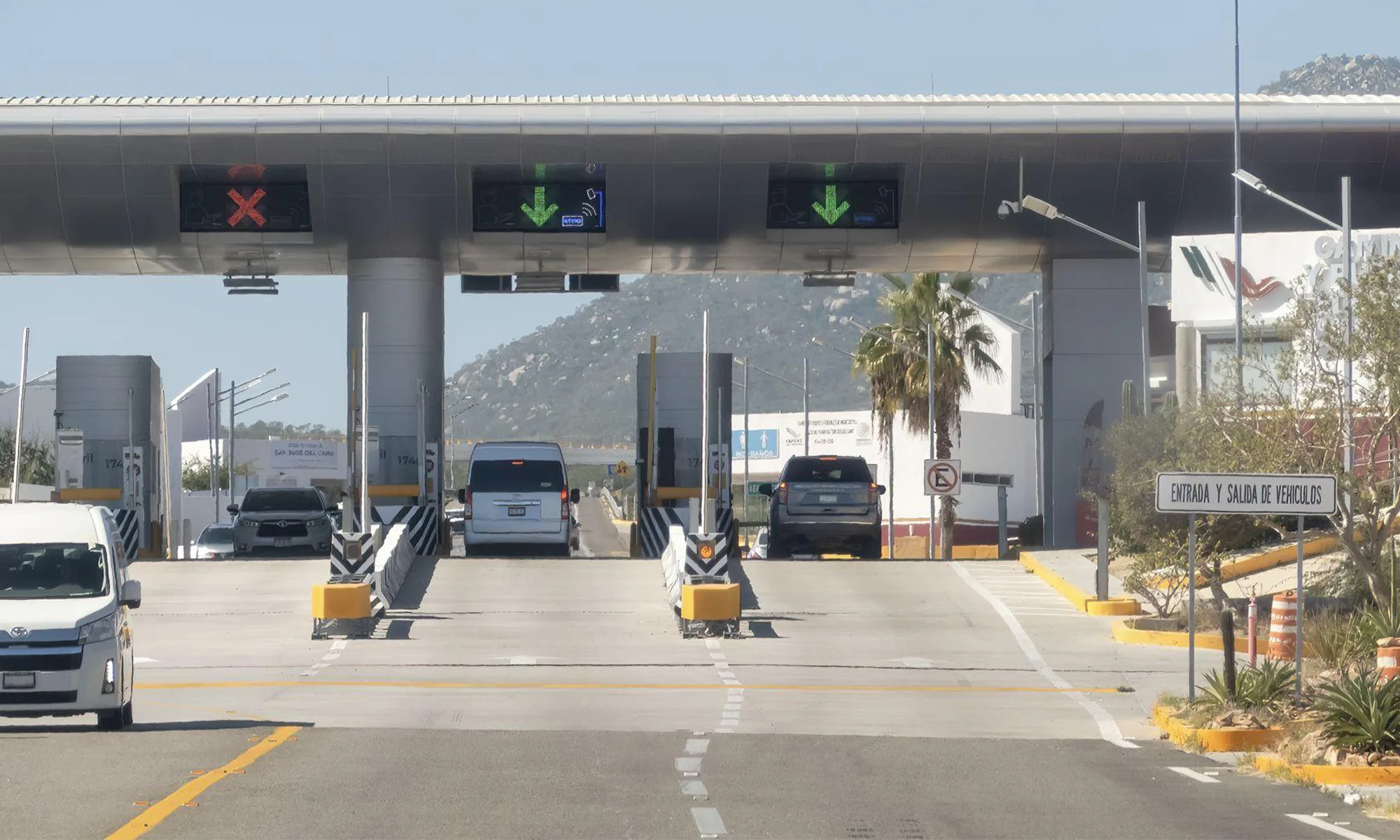
The functional difference between the two roads becomes most apparent during peak demand. Travel across the corridor is highly sensitive to season and time of day. A routine drive between the airport and Cabo San Lucas can take 30 to 40 minutes under stable conditions, but delays on the free highway can extend that significantly when traffic builds or incidents occur.
The toll road shifts from convenient to necessary when pressure builds. It provides a controlled alternative that reduces uncertainty in a system where a single bottleneck can affect the entire corridor. This is particularly relevant for visitors working within fixed schedules, such as flight departures or timed reservations, where variability carries a higher cost than the toll itself.